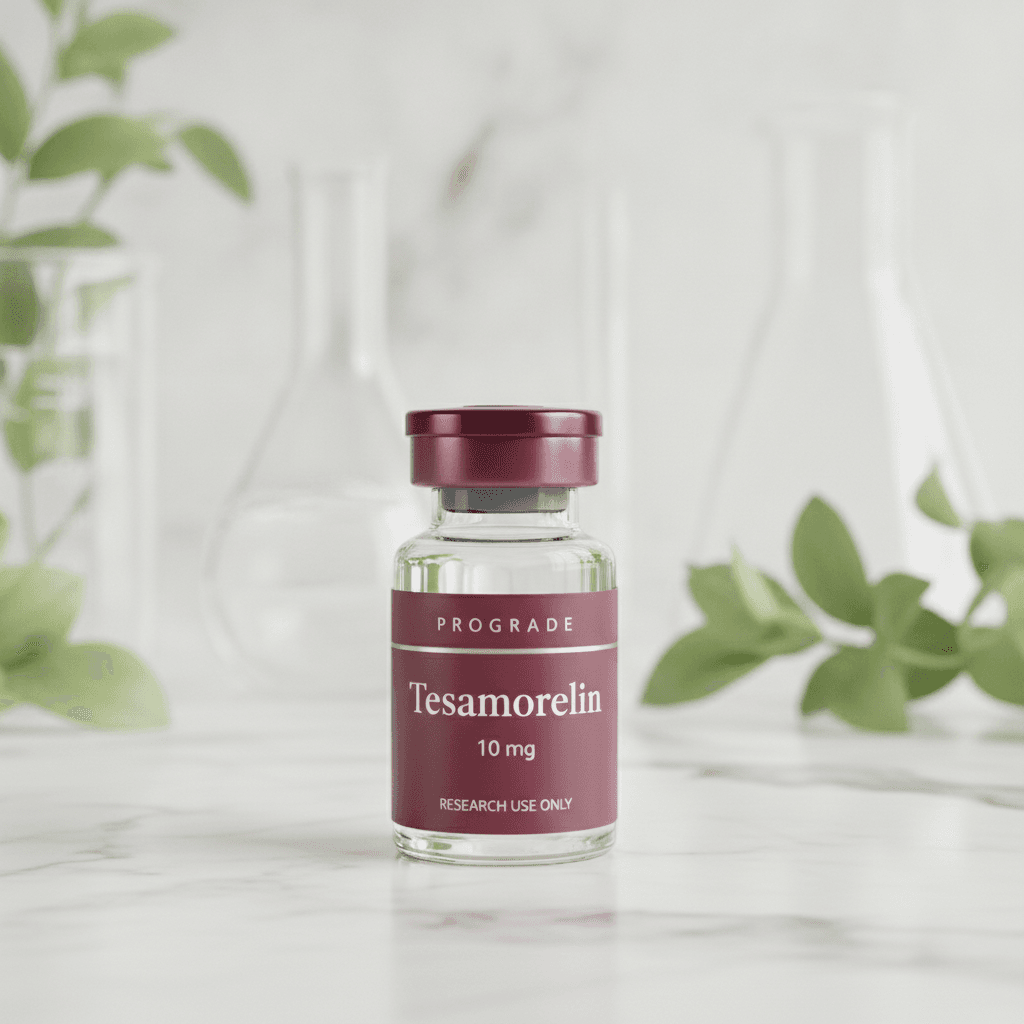
Tesamorelin occupies a specific niche in metabolic and endocrine research as a growth-hormone-releasing hormone (GHRH) analog. This summary explains what a GHRH analog is, why the distinction matters, and how tesamorelin is positioned in the research literature.
Key takeaways
- 1.Tesamorelin is a synthetic analog of growth-hormone-releasing hormone (GHRH).
- 2.It is studied for its relationship to the growth-hormone (GH) axis and visceral adipose tissue.
- 3.As a GHRH analog it acts upstream of growth hormone rather than being growth hormone itself.
- 4.ProGrade supplies tesamorelin at ≥99% purity (HPLC / MS) as a 10 mg vial.
What is tesamorelin?
Tesamorelin is a synthetic peptide analog of growth-hormone-releasing hormone (GHRH). GHRH is the body's natural upstream signal that prompts the pituitary gland to release growth hormone. An "analog" is a modified version of that natural molecule, engineered here for greater stability.
This upstream positioning is the key distinction: tesamorelin is studied as a compound that acts on the signal that governs growth-hormone release, rather than as growth hormone itself.
Tesamorelin and the GH axis
In research models, tesamorelin is examined in the context of the growth-hormone axis — the signaling chain that runs from GHRH to growth hormone to downstream mediators such as IGF-1. Because it works upstream, it is studied as a way to engage that axis at its regulatory starting point.
The other prominent research theme is visceral adipose tissue — the metabolically active fat stored around internal organs. Tesamorelin appears frequently in the metabolic literature that examines this tissue, which is why ProGrade files it under metabolic research alongside its hormone-axis tagging.
As a GHRH analog, tesamorelin acts on the signal that governs growth-hormone release — upstream of growth hormone itself.
How tesamorelin differs from HGH
It is worth distinguishing tesamorelin from recombinant growth hormone (HGH). HGH is growth hormone itself; tesamorelin is a GHRH analog that sits one step upstream in the signaling chain. Researchers studying the GH axis often keep both categories on hand because they engage the system at different points.
That upstream-vs-downstream difference is the main reason the two are catalogued separately even though they touch the same axis.
Form, purity, and handling
Tesamorelin is supplied as a lyophilized powder and prepared with bacteriostatic water before research use. It is stored refrigerated, protected from light, and frozen for long-term storage.
ProGrade specifies ≥99% purity (HPLC / MS) with per-batch COA access.
- Class: GHRH analog (upstream of growth hormone)
- Research themes: GH axis, visceral adipose tissue
- Size: 10 mg research vial
- Purity: ≥99% (HPLC / MS), per-batch COA
Research use only
This article is provided for educational and informational purposes and summarizes published laboratory and preclinical research. All ProGrade Peptides products are sold strictly for in-vitro laboratory and research use only (RUO). Nothing here is medical advice, a therapeutic claim, or a protocol for human or animal use. These compounds are not intended to diagnose, treat, cure, or prevent any disease.
Frequently asked questions
GHRH is growth-hormone-releasing hormone, the body's upstream signal that prompts growth-hormone release. A GHRH analog like tesamorelin is a synthetic, stabilized version of that signaling molecule.
No. HGH is growth hormone itself. Tesamorelin is a GHRH analog that acts one step upstream, on the signal that governs growth-hormone release.
It is studied in the context of the growth-hormone axis and visceral adipose tissue in metabolic and endocrine research models.
No. ProGrade supplies tesamorelin strictly for in-vitro laboratory and research use only.