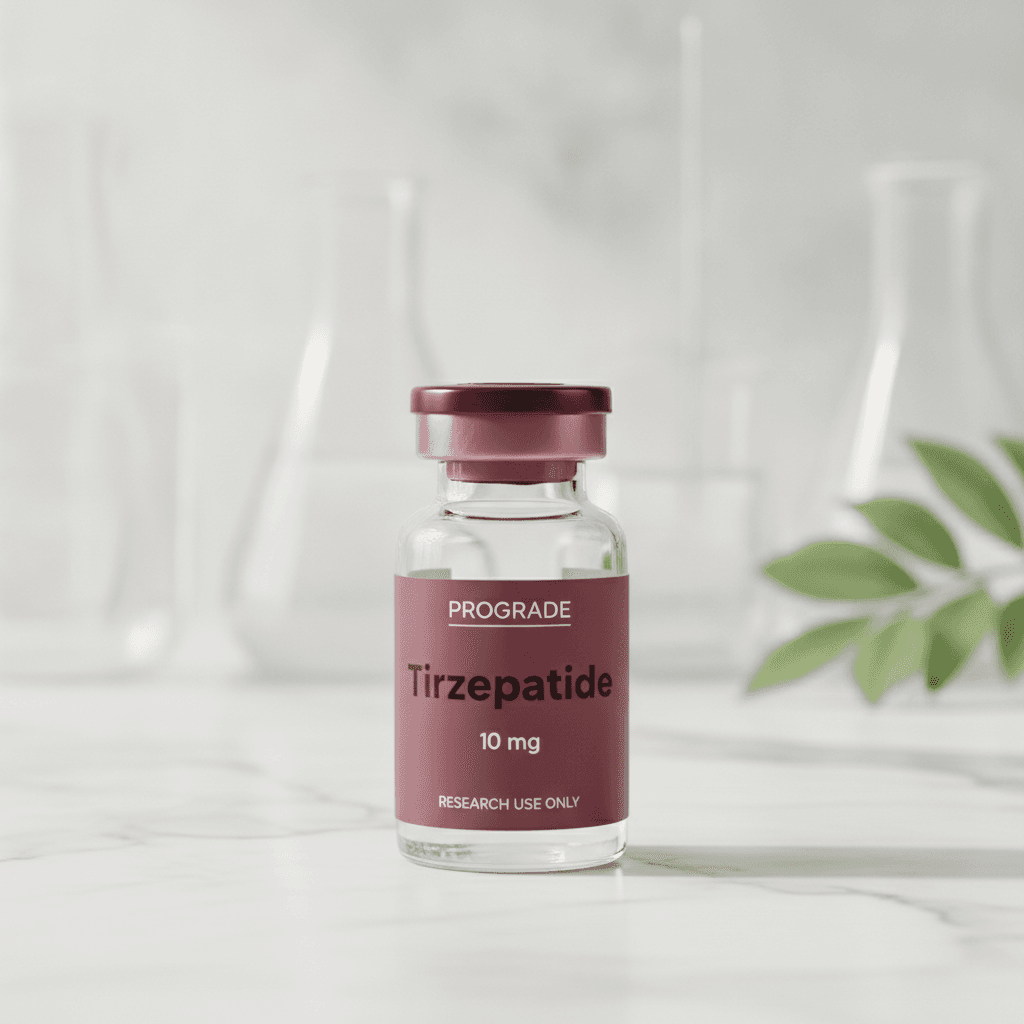
Metabolic research is one of the fastest-moving areas in peptide science, and the vocabulary can be hard to navigate: agonists, incretins, amylin analogs, GHRH analogs. This field guide maps the major categories of metabolic research peptides, explains how they relate to one another, and points to where each sits in ProGrade's MODE-M catalog — all framed for laboratory study.
Key takeaways
- 1.Metabolic research peptides cluster into a few mechanistic families: incretin agonists, amylin analogs, and GHRH analogs.
- 2.Incretin agonists range from single-receptor to dual (tirzepatide) to triple (retatrutide) coverage.
- 3.Amylin analogs such as cagrilintide are studied on a separate but complementary satiety axis.
- 4.All of these are supplied for in-vitro laboratory research use only.
Why metabolic peptides dominate current research
The metabolic peptide category has expanded rapidly because a single design idea — engaging metabolic signaling receptors with an engineered peptide — turned out to be extraordinarily productive. Each new compound tends to add or combine receptor targets, which gives researchers a growing set of tools to study how different signaling axes interact.
The result is a family of compounds that are best understood in relation to one another. Learning the categories is more useful than memorizing individual names, because the categories tell you what each compound is designed to do in a study model.
Incretin agonists: single, dual, and triple
The largest category is the incretin agonists. Incretins are gut-derived hormone signals (GLP-1 and GIP among them) involved in glucose handling and energy balance. Research compounds in this family are grouped by how many of those receptors they engage.
Single-agonist compounds engage the GLP-1 receptor alone. Dual agonists such as tirzepatide engage both GLP-1 and GIP. Triple agonists such as retatrutide add glucagon-receptor activity as a third target. This single-dual-triple ladder is the backbone of the metabolic catalog, and studying compounds across it is how researchers isolate the contribution of each receptor.
- Single agonist — GLP-1 receptor only
- Dual agonist — GLP-1 + GIP (tirzepatide)
- Triple agonist — GLP-1 + GIP + glucagon (retatrutide)
The single-dual-triple agonist ladder is the backbone of metabolic peptide research — each rung isolates the contribution of another receptor.
Amylin analogs: a complementary satiety axis
Alongside the incretins sits a different family: amylin analogs. Amylin is a hormone co-secreted with insulin, studied for its role in satiety and gastric signaling. Long-acting amylin analogs such as cagrilintide are investigated on this separate axis, and are often studied in combination with incretin agonists because the two systems are complementary.
This is why a complete metabolic research catalog includes an amylin analog: it lets investigators study satiety signaling from an angle the incretin compounds don't cover.
GHRH analogs and GH-fragment compounds
A third cluster touches metabolism through the growth-hormone axis. Tesamorelin, a GHRH analog, is studied in the context of visceral adipose tissue and the GH axis. AOD-9604, a modified growth-hormone fragment (176-191), is studied specifically in lipid-metabolism research.
These compounds show that "metabolic research" is broader than the incretin story — the growth-hormone axis provides a parallel set of research targets that intersect with energy balance and fat metabolism.
Mapping the categories to MODE-M
ProGrade organizes these compounds under MODE-M · Metabolic. Retatrutide (triple agonist) and tirzepatide (dual agonist) anchor the incretin family; cagrilintide represents the amylin axis; tesamorelin brings the GHRH analog; and AOD-9604 covers the GH-fragment lipid-metabolism angle. Together they give a research program coverage across every major metabolic-signaling family in one catalog.
When you shop by result, the MODE-M grouping is the fastest way to see the whole metabolic toolkit at once, each compound documented with per-batch COA access at ≥99% purity.
Research use only
This article is provided for educational and informational purposes and summarizes published laboratory and preclinical research. All ProGrade Peptides products are sold strictly for in-vitro laboratory and research use only (RUO). Nothing here is medical advice, a therapeutic claim, or a protocol for human or animal use. These compounds are not intended to diagnose, treat, cure, or prevent any disease.
Frequently asked questions
Incretin agonists engage the GLP-1 and/or GIP receptors, which are part of the gut incretin system. Amylin analogs like cagrilintide act on a separate satiety axis and are often studied in combination with incretin compounds.
Triple agonists such as retatrutide engage three receptors (GLP-1, GIP, and glucagon), compared with dual agonists like tirzepatide (two) and single agonists (one).
Yes. GHRH analogs such as tesamorelin are studied in the context of visceral adipose tissue and the growth-hormone axis, which places them within metabolic research.
No. Every metabolic peptide in the ProGrade catalog is supplied strictly for in-vitro laboratory and research use only.