Few molecules appear across as many corners of cell biology as NAD+. It sits at the intersection of energy metabolism, DNA repair, and the sirtuin pathways that longevity research revolves around. This primer explains what NAD+ is and why it has become a fixture of cellular-aging research, framed for laboratory study.
Key takeaways
- 1.NAD+ (nicotinamide adenine dinucleotide) is a coenzyme present in every living cell.
- 2.It is central to energy metabolism, DNA-repair enzymes, and sirtuin signaling — all core longevity-research themes.
- 3.Cellular NAD+ availability is a widely studied variable in aging models.
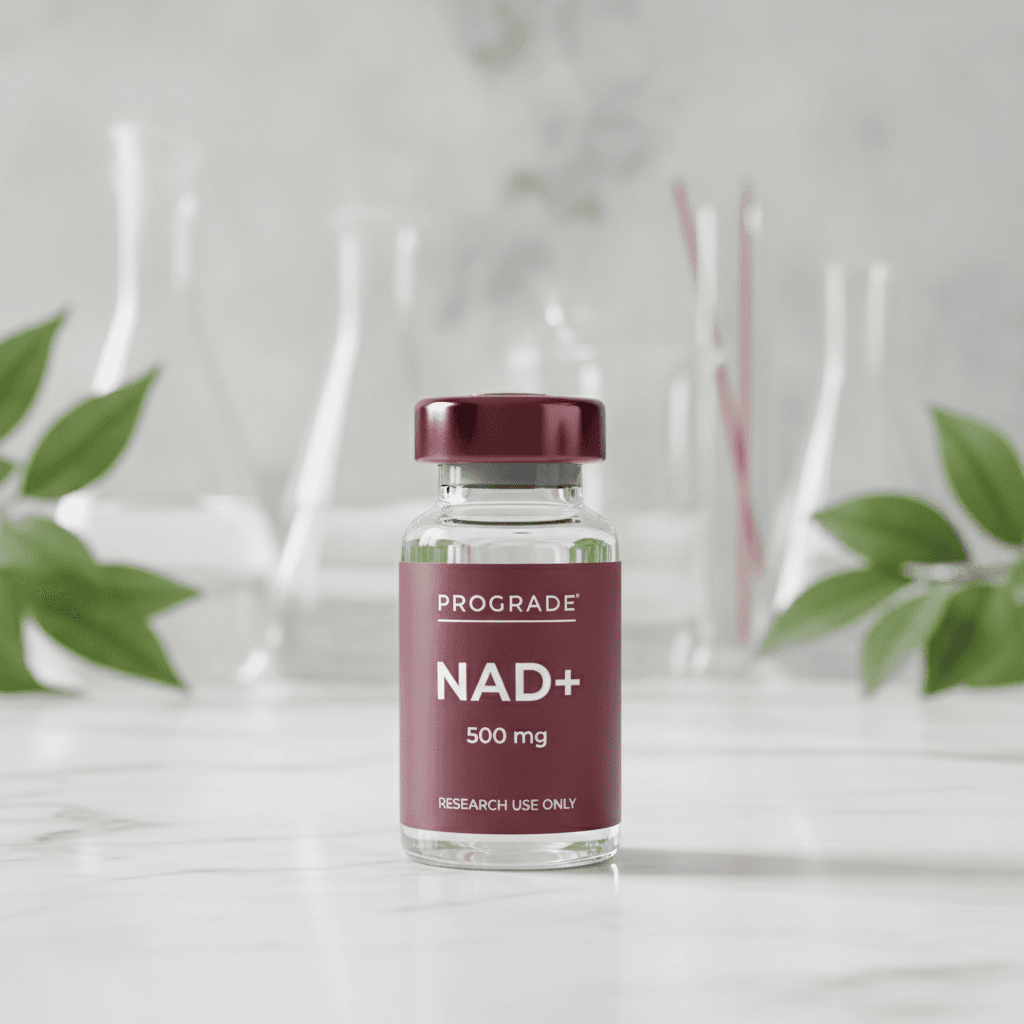
- 4.ProGrade supplies NAD+ at ≥99% purity (HPLC / MS) as a 500 mg research vial.
What is NAD+?
NAD+ stands for nicotinamide adenine dinucleotide. It is a coenzyme — a small helper molecule that many enzymes require to function — and it is found in every living cell. Its best-known role is as an electron carrier in the reactions that convert nutrients into cellular energy.
But NAD+ is more than a metabolic workhorse. It is also a required substrate for several families of enzymes that consume it as they operate, which is what links it so tightly to aging research.
Why NAD+ matters in longevity research
Three research themes converge on NAD+. First, energy metabolism: NAD+ shuttles electrons through the reactions that generate ATP, so its availability is tied to mitochondrial function. Second, DNA repair: enzymes involved in repairing DNA damage consume NAD+ as they work. Third, the sirtuins — a family of signaling enzymes studied heavily in longevity science — depend on NAD+ as a required cofactor.
Because all three of these processes draw on the same pool, cellular NAD+ availability becomes a shared variable that ties energy, genomic maintenance, and longevity signaling together. That convergence is exactly why NAD+ is so heavily studied in aging models.
Energy metabolism, DNA repair, and sirtuin signaling all draw on the same NAD+ pool — which is what makes it a keystone variable in aging research.
The cellular-aging connection
A recurring observation in the literature is that cellular NAD+ levels are studied as a variable that changes with age in model systems. This has made NAD+ availability a central question in longevity research: investigators examine how NAD+-consuming and NAD+-generating pathways balance over time.
This is the reason NAD+ is filed under longevity research alongside compounds such as epithalon and glutathione — they are all studied in the context of cellular maintenance and aging biology.
Form, purity, and handling
ProGrade supplies NAD+ as a 500 mg lyophilized research vial, prepared with bacteriostatic water before use. Like other lyophilized compounds it is stored refrigerated, protected from light, and frozen for long-term storage.
Purity is specified at ≥99% (HPLC / MS) with per-batch COA access, so each lot's identity is documented for reproducible research.
- Class: cellular-energy coenzyme (nicotinamide adenine dinucleotide)
- Research themes: energy metabolism, DNA repair, sirtuin signaling
- Size: 500 mg research vial
- Purity: ≥99% (HPLC / MS), per-batch COA
Research use only
This article is provided for educational and informational purposes and summarizes published laboratory and preclinical research. All ProGrade Peptides products are sold strictly for in-vitro laboratory and research use only (RUO). Nothing here is medical advice, a therapeutic claim, or a protocol for human or animal use. These compounds are not intended to diagnose, treat, cure, or prevent any disease.
Frequently asked questions
NAD+ stands for nicotinamide adenine dinucleotide, a coenzyme found in every living cell that participates in energy metabolism and several enzyme pathways.
NAD+ is a shared cofactor for energy metabolism, DNA-repair enzymes, and the sirtuin signaling pathway — three processes central to cellular-aging science — so its availability is a heavily studied variable in aging models.
Sirtuins are a family of signaling enzymes studied in longevity research. They require NAD+ as a cofactor to function, which is one of the reasons NAD+ is so closely tied to aging biology.
No. It is supplied strictly for in-vitro laboratory and research use only.