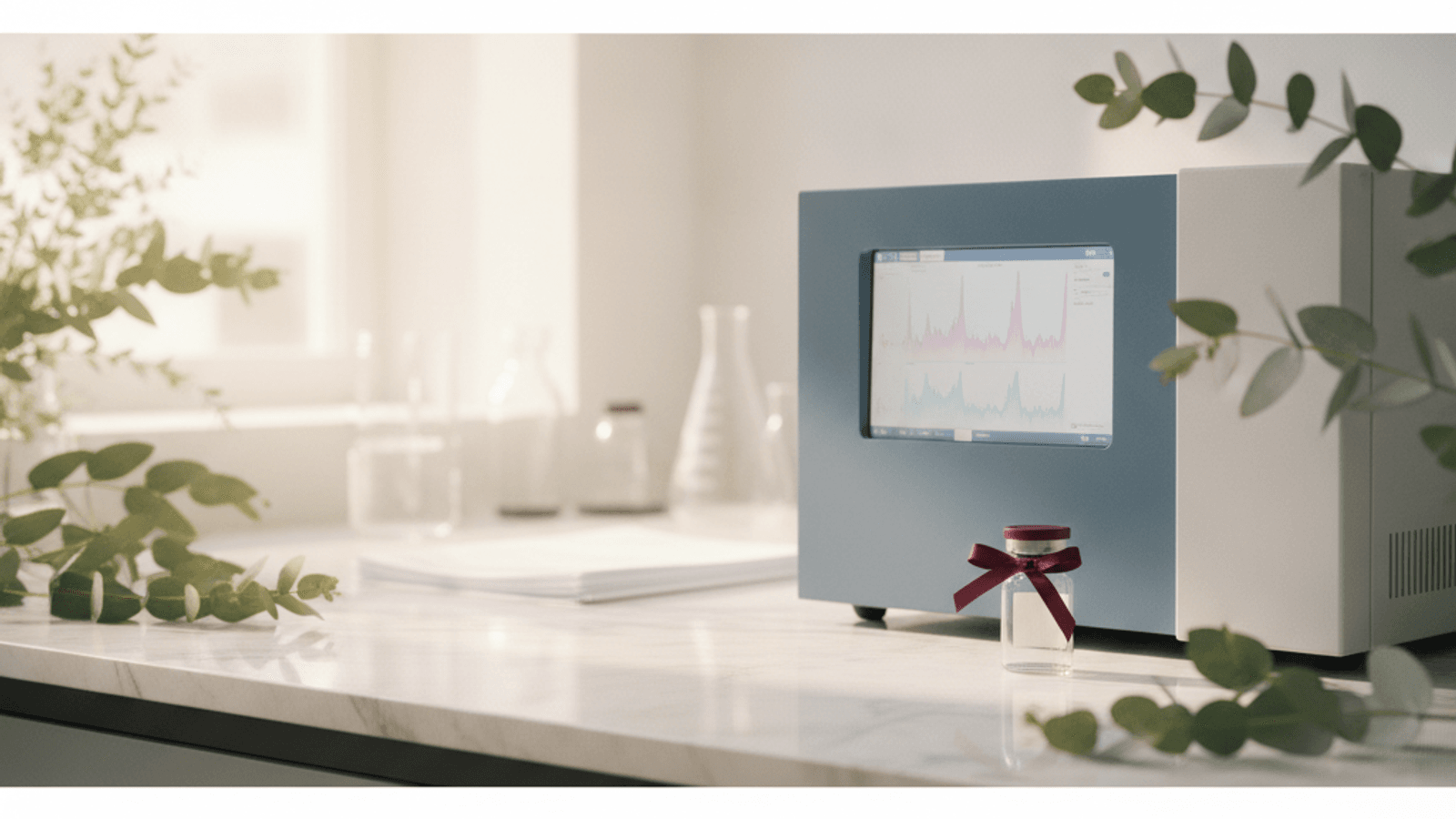
When a certificate of analysis reads "HPLC / MS," it is naming the two instruments that stand behind every purity claim worth trusting. They are not interchangeable — each answers a different question, and a compound is only fully characterized when both have run. This guide explains what high-performance liquid chromatography and mass spectrometry each do, in plain language, and why the pair is the standard for research-peptide verification.
Key takeaways
- 1.HPLC measures purity — how much of the sample is the target compound versus impurities.
- 2.Mass spectrometry measures identity — whether the molecule present matches the target's molecular weight.
- 3.Purity and identity are different questions; a rigorous COA reports both, not one.
- 4.ProGrade verifies every compound by HPLC and MS and provides per-batch COA access at ≥99% purity.
What HPLC measures: purity
High-performance liquid chromatography (HPLC) is a separation technique. A tiny amount of the dissolved sample is pushed through a packed column under high pressure, and the different molecules in the sample travel through that column at different speeds. As each component exits, a detector records it as a peak on a graph called a chromatogram.
The value of this is that it separates the target compound from everything else. The target peptide shows up as one large peak; any impurities or byproducts appear as smaller peaks. The relative area of the target peak is the purity figure — so when a COA says ≥99% purity, it means HPLC found that at least 99% of the detected material was the target compound.
HPLC separates a sample into peaks — the target compound is the big one, and its relative size is the purity number.
What mass spectrometry measures: identity
Mass spectrometry (MS) answers a different question: is this the right molecule at all? An MS instrument ionizes the sample and measures the mass-to-charge ratio of the resulting ions, producing a spectrum. Because every peptide has a known, characteristic molecular weight, that measured mass acts as a fingerprint.
If the dominant mass signal matches the expected molecular weight of the target peptide, its identity is confirmed. MS says nothing about how clean the sample is — a mislabeled impurity could in principle be pure — which is exactly why it is paired with HPLC rather than used alone.
Why a real COA uses both
The two methods cover each other's blind spots. HPLC can tell you a sample is 99% one thing without telling you what that thing is. MS can confirm a molecule's identity without telling you whether the rest of the vial is impurity. Only together do they establish that the compound is both the correct molecule and present at high purity.
This is why the phrase "HPLC / MS" on a certificate is meaningful shorthand: purity measured by chromatography, identity confirmed by spectrometry. A COA that names only one method has verified only half of the question.
- HPLC → purity (how much of the sample is the target)
- MS → identity (is it the correct molecule)
- Together → correct molecule AND high purity, documented
- One method alone → only half the characterization
The two-method standard in practice
For research procurement, the practical takeaway is to expect both methods on the certificate, tied to your batch. A supplier that runs HPLC and MS on each lot is documenting reproducibility rather than asserting it — and reproducibility is the whole point of buying a characterized research compound instead of an unknown powder.
ProGrade specifies ≥99% purity by HPLC with identity confirmed by MS, with per-batch COA access across the catalog. That two-method, per-lot standard is what lets a research program treat the compound's identity and purity as documented facts.
Research use only
This article is provided for educational and informational purposes and summarizes published laboratory and preclinical research. All ProGrade Peptides products are sold strictly for in-vitro laboratory and research use only (RUO). Nothing here is medical advice, a therapeutic claim, or a protocol for human or animal use. These compounds are not intended to diagnose, treat, cure, or prevent any disease.
Frequently asked questions
HPLC separates a sample to measure purity — the fraction that is the target compound. Mass spectrometry measures molecular mass to confirm identity — that the molecule is the correct one. They answer different questions and are used together.
Not on its own. HPLC measures how pure a sample is by separating its components into peaks, but confirming that the main peak is the correct molecule requires mass spectrometry. That is why a thorough COA reports both.
It reflects the relative size of the target compound's peak compared with all detected peaks. A ≥99% figure means HPLC found the target made up at least 99% of the detected material, with impurities below 1%.
Yes. ProGrade verifies each compound with HPLC for purity and mass spectrometry for identity, and provides per-batch COA access at ≥99% purity.